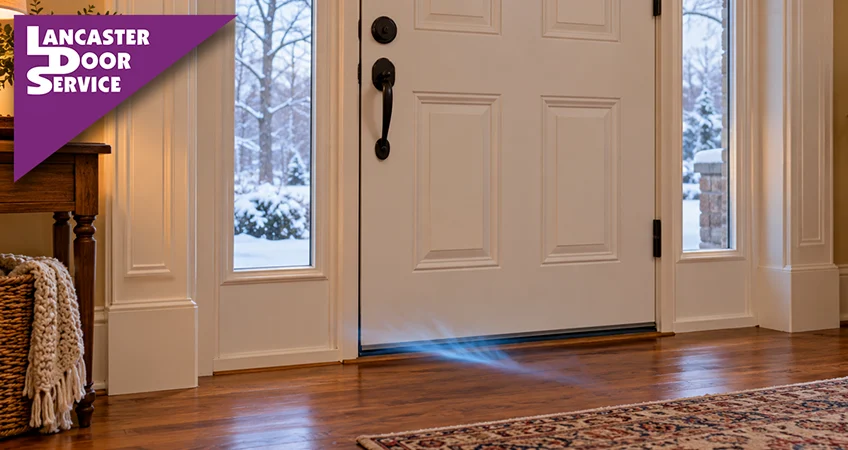
Winter is coming to Lancaster County, and your front door may already be working against you. A drafty door doesn’t announce itself. It shows up as a cold spot by the entryway, a heating system that works harder than it should, or an energy bill that keeps climbing. The good news: most door drafts are easy to find and often cheap to fix. Here’s how to track yours down, what to do about it, and when a new door makes more sense.
What Is a Draft in Your Door?
A draft is outside air slipping into your home through gaps around a door. Heated air escapes, cold air takes its place, and your home struggles to stay comfortable. Doors account for about 11% of the heat loss in a typical home, and old or worn doors leak even more.
Most drafts trace back to a few common problems:
- Weatherstripping that has worn out, compressed, or torn
- A missing or worn door sweep at the bottom
- A door that has fallen out of alignment, or hinges and pins that have worn down
- A threshold that doesn’t sit flush
- Cracked or unsealed seams
How Do You Find a Draft Around a Door?
You don’t need special tools. Try these checks:
- Look for daylight. If you can see light around the frame, air is getting through. Please note, this only applies to entry doors, not storm doors.
- Rattle the door. Movement means possible leaks.
- Use your hand. Slide it along the sides, top, and bottom. TIP: A damp hand makes cool air easier to feel.
- Use a flashlight. Shine it around the edges in a dark room.
- Check the bottom. Gaps under a door are easy to miss because you walk right over them.
Extra noise, dust, or moisture near the door are also clues, as is weatherstripping that looks cracked, flattened, or torn.
What Are the Best Ways to Fix a Drafty Door?
Start with the simplest fixes first.
Replace the weatherstripping. This is the most common fix. Foam weatherstripping presses into the groove along the door jamb, can be trimmed to fit, and usually takes only basic household tools. V-strip, tubular, magnetic, and compression styles are all available.
Add a door sweep. A sweep closes the gap under the door and should touch the threshold without dragging enough to stop the door from opening smoothly.
Caulk the fixed gaps. Caulk seals joints that don’t move, like where trim meets the frame, while weatherstripping handles the moving parts.
Check alignment and hardware. Worn hinges and pins can keep a door from sealing, and on a wood door, repositioning the latch plate can close a leak.
Consider adding a storm door. A properly installed storm door creates an additional barrier against wind and cold air. The air space between the storm door and entry door can also help reduce heat loss during winter. However, a storm door is not a substitute for proper weatherstripping and sealing around your main entry door.
Check your weatherstripping once a year. Sealing air leaks around a home can save an estimated 5% to 30% on energy annually.
When Should You Replace a Drafty Door?
Sealing is often enough, and the right hardware can save you from replacing the whole door. But if drafts continue after sealing and adjusting, if your entry door is old and rattling, or if the frame is rotted, replacement is the better move. Rot in the frame and sill is the most common problem found when replacing front doors, and it can reach into the subfloor. Newer insulated doors have foam cores and R-values from 6 to 12, which can dramatically reduce heat loss.
Which Entry Doors Help Prevent Drafts?
Lancaster Door Service sells and installs ProVia entry doors in fiberglass, smooth steel, and textured steel. A few to look at on lancasterdoor.com:
- Signet® (fiberglass): realistic woodgrain looks with strong energy performance.
- Ascent™ (fiberglass): attractive selection of stain and paint finishes, plus inscribed doors. [Note: Being rebranded as “Venture” in 2027.]
- Legacy™ (steel): 20-gauge steel with a reinforced lock and deadbolt area.
- ProVia Storm Doors: Spectrum™, Decorator™, Deluxe™, DuraGuard™, and Superview™ add an extra barrier.
Glass deserves a look too. Sliding glass doors lose heat faster than other door types because glass is a poor insulator, so ProVia patio doors and replacement windows are worth considering if those are your drafty spots. Our installers make sure each door is a precise, functional fit, and we guarantee our work.
Ready to stop the draft? Visit our showroom at 1851 Lincoln Hwy East in Lancaster, call (717) 394-4724, we’re open Monday through Friday, 7 AM to 4 PM, or request a quote on our website today!