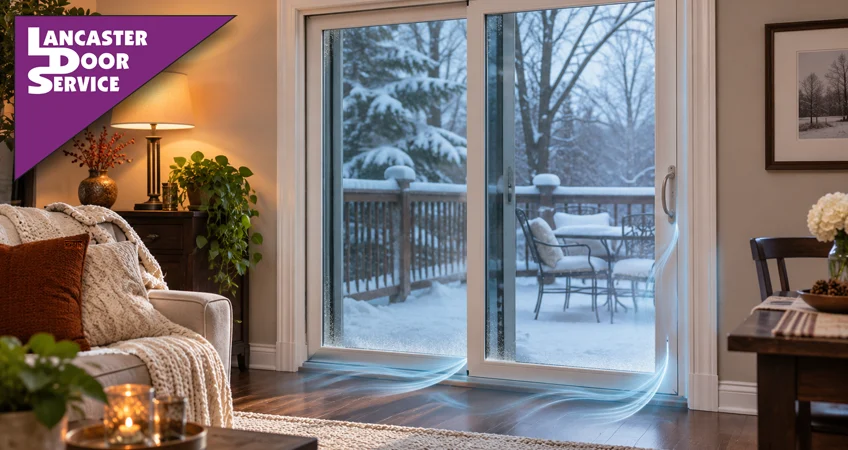
If the area near your sliding glass door is the chilliest part of your home, you’re not imagining it. Patio doors lose heat faster than most other doors, and once the heat is on in Lancaster County, you feel it. A few simple checks can tell you whether you need a quick fix or a new door.
Why do patio doors lose so much heat?
A patio door is mostly glass, and glass is a very poor insulator. According to the U.S. Department of Energy, sliding glass doors lose more heat than most other door types, and older single-pane doors are the biggest offenders.
Design plays a part, too. A sliding door has to move, so it can’t be sealed as tightly as a door that swings, and its weatherstripping wears down with use. That means air leakage tends to grow as the door ages. Hinged patio doors generally seal tighter than sliders, and a door with one fixed panel leaks less than one with two operating panels.
How can you tell if your patio door is drafty?
Start with your hand. On a windy day, slide it slowly along the edges, where the panels meet, and along the bottom track. Moving air means a leak. Then look at the weatherstripping for cracks, flattened spots, or gaps. Our guide to finding and fixing a drafty door covers more ways to track down leaks around your home.
What can you do about a drafty patio door this week?
Most patio door drafts have simple fixes. Start here:
- Clean the track and clear the weep holes. Weep holes are the small drain slots at the bottom of the door. Keeping them and the track free of dirt helps water drain and the door slide smoothly.
- Check the weatherstripping. Wipe off grit, and replace worn strips if the manufacturer makes that possible. The Department of Energy recommends checking weatherstripping once a year.
- Inspect the exterior caulk. Replace it where it has cracked or pulled away from the frame.
- Close insulating shades at night. Cellular shades add a layer between the glass and the room.
- Add a temporary layer. Thermal-lined curtains, a draft stopper at the base, or clear window film can help through the coldest months.
Do the first three before the cold settles in. They cost little, and they show you how much of the problem is the seal rather than the door itself.
When is it time to replace a patio door?
Sealing and cleaning can only do so much. Consider a new door if drafts continue after you’ve sealed it, if it’s hard to slide or lock, or if the glass has fogged between the panes, which usually means the seal around the glass has failed.
Newer doors fix the root problem. Look for multiple layers of glass, low-e coatings, and argon gas between the panes. Those features are worth paying for, because they slow heat loss through the glass itself. When you compare doors, check the NFRC label on each one, which lists its energy performance ratings. If you’re working with an estimator from a company, tell him or her that energy performance is important to you.
Which patio doors does Lancaster Door Service offer?
We sell and install ProVia patio doors in four lines:
- Aeris: Features a low-maintenance vinyl exterior with a real wood interior available in Oak, Cherry, or Maple, with a variety of painted and stained finishes.
- Endure: An energy-efficient, all-vinyl patio door offering double- and triple-pane glass, decorative finishes, and numerous customization options.
- Aspect: Similar to Endure, but with less options.
- ecoLite: ProVia’s economical sliding patio door, featuring durable all-vinyl construction in white and a traditional two-panel configuration.
Aeris and Endure patio doors feature graphite foam insulation for enhanced thermal performance. Aeris, Endure, and Aspect are available in multi-panel configurations, with internal blinds available on select models. They also utilize a patented water drainage system. All four sliding patio door lines offer ENERGY STAR certified options.
Ready to stop the draft?
Not sure whether you need a repair or a replacement? Stop by our showroom at 1851 Lincoln Highway East in Lancaster, PA 17602. We’re open Monday through Friday, 7 AM to 4 PM. Our installers make sure each door is a precise, functional fit, and we guarantee our work. You can also call (717) 394-4724 or request a free quote online.
FAQ
Is condensation on my patio door a sign it needs to be replaced?
Usually not. ProVia says condensation is often a result of high humidity inside the home, and it does not treat it as a product defect. Running a dehumidifier or a kitchen exhaust fan can help. Film or fog between the panes is different, because that points to a failed glass seal.
What does the NFRC label on a patio door tell me?
It lists the door’s energy performance ratings, including its U-factor and solar heat gain coefficient (SHGC). A lower U-factor means the door holds heat in better. In a climate that needs heating, a higher SHGC lets in more of the sun’s warmth. The label also shows air leakage ratings.
Do I need a storm door on my patio door?
Probably not. The U.S. Department of Energy says storm doors for patio doors are hard to find, and adding one to a newer multi-pane, low-e door seldom pays off. Closing insulating cellular shades at night is the more practical step.
Are ProVia patio doors ENERGY STAR certified?
ProVia offers ENERGY STAR certified options in all four of its patio door lines: Aeris, Endure, Aspect, and ecoLite. Certification depends on the glass package and configuration, so ask us which versions qualify for our climate zone.